Which Is Right for You? A decision that shapes the next 25 years — what you eat, how you speak, and how confidently you smile.
Choosing between dental implants and dentures is not simply a dental decision. It’s a quality-of-life decision: it determines whether you’ll order the steak or scan the menu for something soft, whether you’ll laugh freely or hesitate, and how your face ages over time. A decision like that deserves complete, honest information.
Considering the Switch?
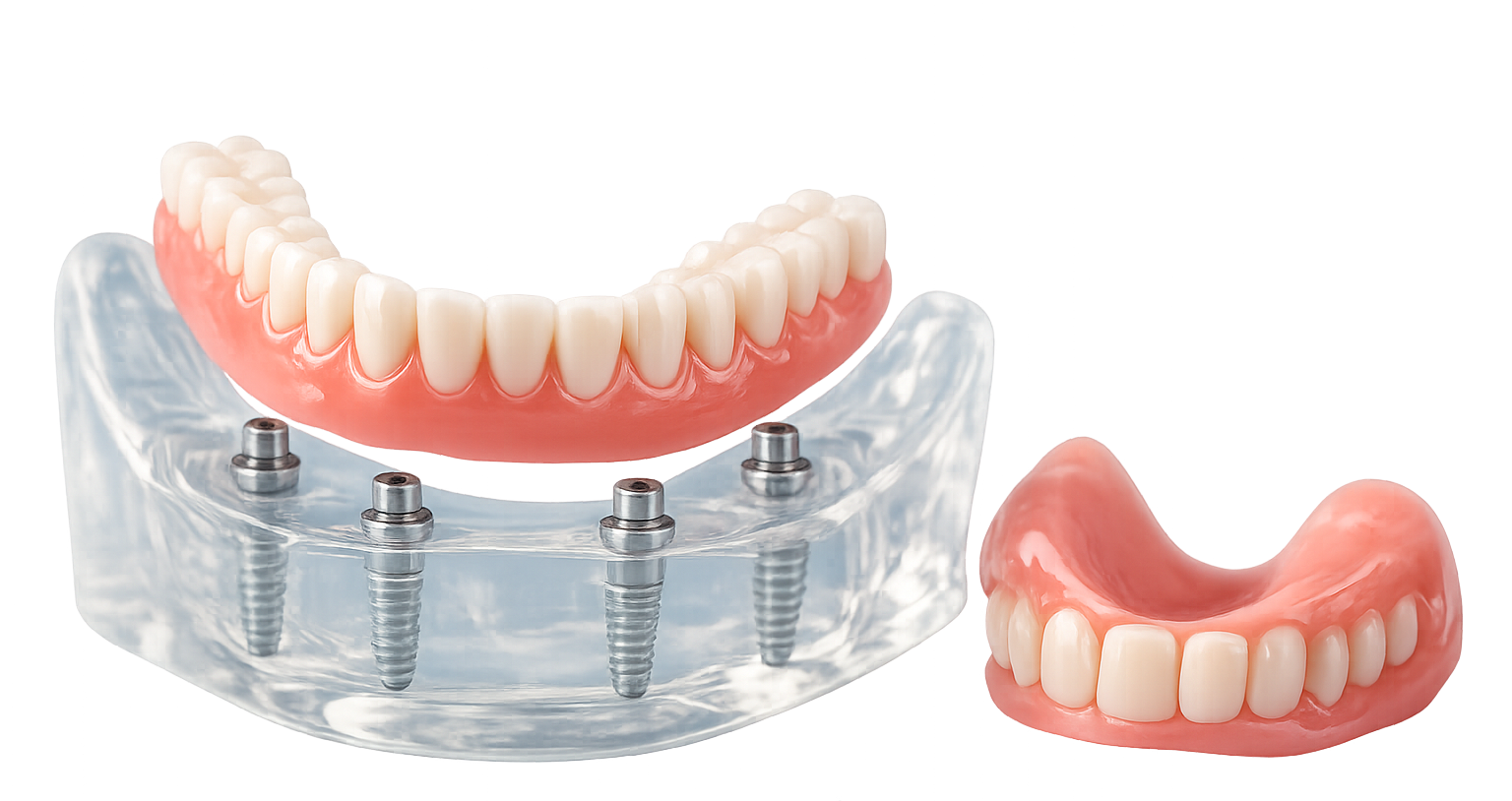
Removable dentures were the default solution for missing teeth for decades — affordable, accessible, and for many patients, the only realistic option. A traditional denture is an acrylic appliance that rests on your gums, held in place by suction or adhesive, and removed at night for cleaning.
Dental implants — and in particular full-arch All-on-X treatment — have fundamentally changed what’s possible. A small number of implants anchor a complete set of fixed teeth that never come out, restoring near-natural function while doing something no denture can:
preserving the jawbone underneath.
Today, patients no longer have to accept the daily compromises that come with removable dentures — the slipping, the dietary restrictions, the adhesives, and the progressive bone loss
dentures accelerate over time. The question is which trade-offs matter most to you.
A denture is an appliance sitting on soft tissue. Pressure points, sore spots, and — for upper dentures — a plate covering the roof of your mouth are part of the package, and as the jaw changes shape, the fit only gets worse. Implant-supported teeth transfer chewing forces into the bone the way natural teeth do: nothing presses on your gums, nothing covers your palate, and nothing needs adhesive to stay put.
This is the factor most patients have never been told. Your jawbone stays strong because tooth roots stimulate it; remove the teeth and the bone begins to resorb. Dentures don’t just fail to stop this — the constant pressure of an appliance rubbing on the ridge accelerates it. Implants are the only tooth-replacement option that acts like roots, signaling the bone to stay. Every year in a denture is a year of bone quietly disappearing; every year with implants is a year of bone preserved.
That bone loss shows up in the mirror. As the jaw shrinks, the lower face shortens, lips thin, and cheeks hollow — the classic “denture look” that ages people beyond their years. By maintaining the bone, implants maintain the facial structure it supports, while fixed teeth designed by a prosthodontist restore natural proportions to your smile.
Category 01 · What You Can Eat
Category 02 · How They Feel
Category 03 · How You'll Look in 10 Years
Category 04 · How They Look
Category 05 · Care Required
Category 06 · 25-Year Investment
$2,500
$2,500
$12,500
25 years · Often $20,000+
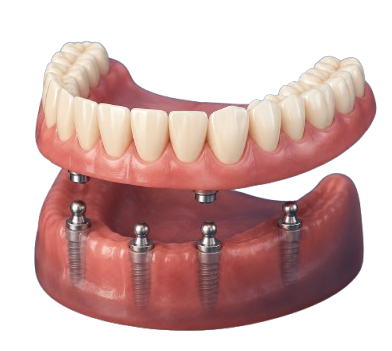
There’s also a path between the two. A snap-in overdenture is a removable denture that clips onto two to four implants — dramatically more stable than a traditional denture, gentler on your budget than a fixed full arch, and protective of the bone around each implant. For some patients, it’s the right stepping stone; for others, it’s the destination. Dr. Winfield will walk you through all three options with real numbers at your consultation.
Long-time denture wearers often assume years of bone loss have priced them out of implants. Frequently, that’s no longer true. All-on-X treatment angles implants into the densest bone you still have, often eliminating the need for grafting. And for patients with severe bone loss in the upper jaw, Dr. Winfield offers zygomatic implants — longer implants anchored in the sturdy cheekbone, bypassing the deficient jawbone entirely. Even patients who have been turned away elsewhere are often candidates. Your free 3D CBCT scan will show exactly what’s possible for you.
Complete honesty requires saying it: dentures are still the right call for some patients. They make sense when budget realities rule out implant treatment even with financing, when medical conditions make surgery inadvisable, or as a planned interim step while preparing for implants. In those cases, a well-made denture from a prosthodontist — the specialty that literally trains on dentures — will fit and function far better than a bargain appliance. And if stability is the main
complaint, a snap-in overdenture can often be added later.
For most patients, yes — and often the math alone settles it. Dentures require replacement every 5–7 years plus relines and adhesives for life, while accelerating the bone loss that makes future treatment harder. Over 25 years, implants are frequently comparable in total cost, while delivering fixed teeth, full chewing power, and preserved facial structure the entire time.
Very often, yes — it’s one of the most common transformations we perform. Dr. Winfield’s CBCT scan maps your remaining bone; angled All-on-X placement uses your densest available bone, and zygomatic implants can restore even severely resorbed upper jaws that other offices have declined to treat.
An implant-supported overdenture: a removable denture that clips securely onto two to four implants. It ends the slipping and most adhesive use, at a lower cost than a fixed full arch — a genuine middle path between traditional dentures and All-on-X.
Traditional dentures typically need relining or replacement every 5–7 years as the jaw changes shape. Dental implants can last decades — often a lifetime — with good home care and regular hygiene visits.
Implants stimulate the jawbone the way natural roots do, halting the progressive bone loss that causes facial collapse. They can’t restore bone already lost — which is why acting sooner protects more of your natural facial structure — but they stop the clock, and your new teeth are designed to restore natural proportions to your smile.
A one-on-one evaluation with Dr. Winfield and a 3D CBCT scan of your jaw — the same imaging used to plan treatment. You’ll leave knowing whether you’re a candidate, which options fit your case, and exactly what each would cost. There’s no obligation to proceed.
You deserve to make this decision with complete information — not guesswork. Get a precise, expert assessment of your options, including your free 3D CBCT scan, with Dr. Winfield.
Winfield Dental Group — Home of Winplants® 1111 6th Ave, Suite 102, San Diego, CA 92101
Winplants® is a registered trademark of Winfield Dental Group. Individual results vary; candidacy is determined after a clinical exam and 3D imaging.
Call (619) 363-5900 or request an appointment online to get started. We proudly serve patients from downtown San Diego and throughout San Diego County.
"*" indicates required fields