A secure, non-removable bridge anchored on dental implants — restoring multiple teeth without grinding down healthy ones.
Replace 3–4 missing teeth with one fixed restoration — without an implant under every tooth. WINPLANTS implant-supported bridges from San Diego’s board-certified prosthodontist.
Need Full Arch?
An implant-supported bridge is a fixed (non-removable) dental bridge anchored on 2 or 3 dental implants rather than natural teeth. It replaces three or more adjacent missing teeth with a single connected restoration — often the most economical implant solution for patients with multiple
missing teeth in the same area.
The key difference from a traditional bridge: instead of grinding down two healthy neighboring teeth to serve as anchors, titanium implants do the anchoring. Your remaining healthy teeth stay completely untouched, and the implants prevent the bone loss that follows any tooth loss.
At WINPLANTS, part of the Winfield Dental Group, every implant bridge is planned using our complete digital workflow — CBCT 3D imaging, digital smile design, and guided surgery for precise implant placement — and crafted from premium zirconia or porcelain, engineered to look natural and last decades.
For patients missing 3–4 adjacent teeth, an implant-supported bridge often offers the best cost-to-result ratio in implant dentistry: the longevity and bone protection of implants, without paying for an implant under every single tooth.
The number of implants and bridge length depends on how many adjacent teeth you’re replacing. Here are the three most common configurations.
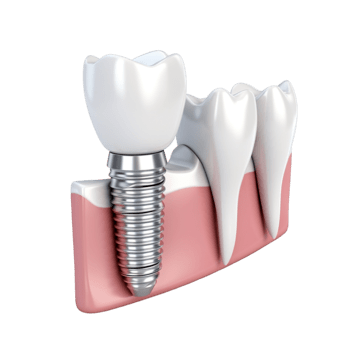
2 Implants · 3 Crowns
Teeth Replaced
3 adjacent
Implants Required
2
Treatment Time
3–6 months
Best For
3 missing teeth in a row
From $9,000
From $300/mo 0% APR
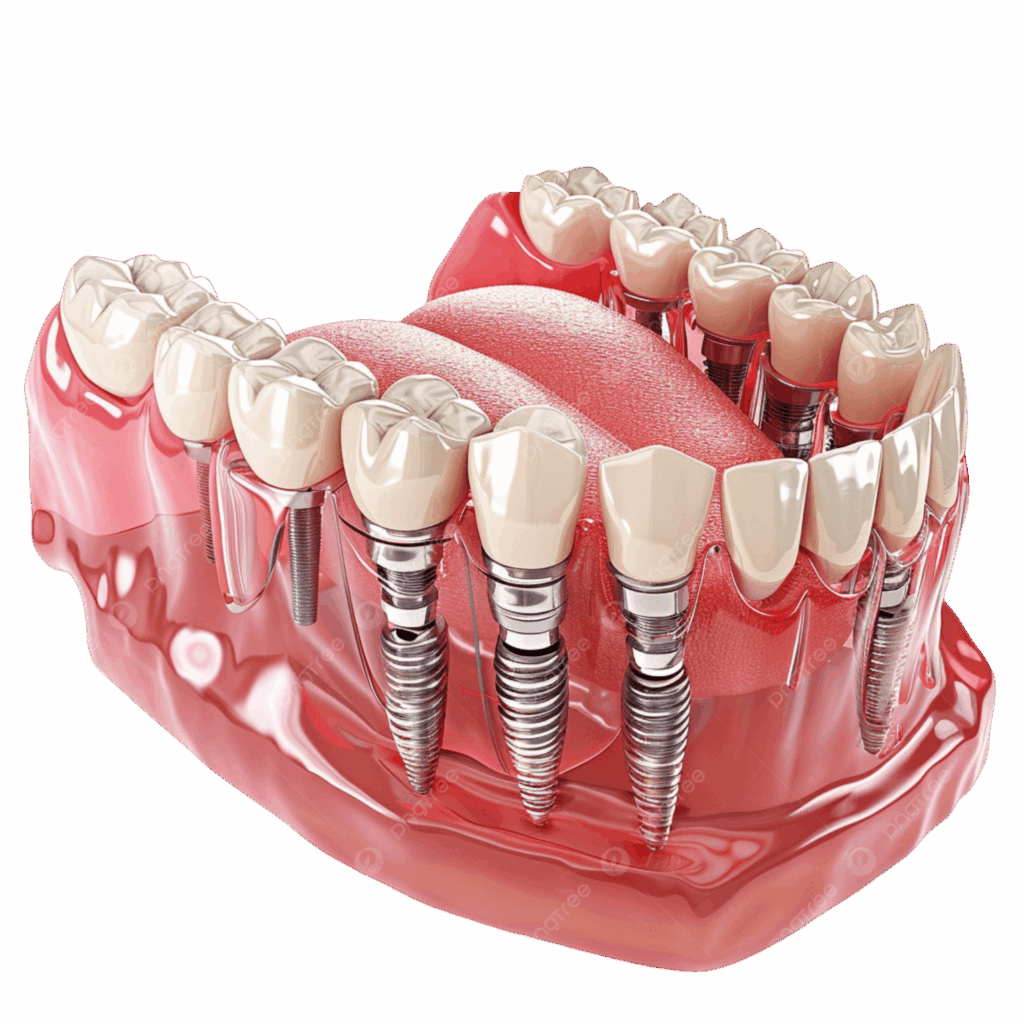
Teeth Replaced
4 adjacent
Implants Required
2
Treatment Time
3–6 months
Best For
4 missing teeth in a row
From $11,500
From $385/mo 0% APR
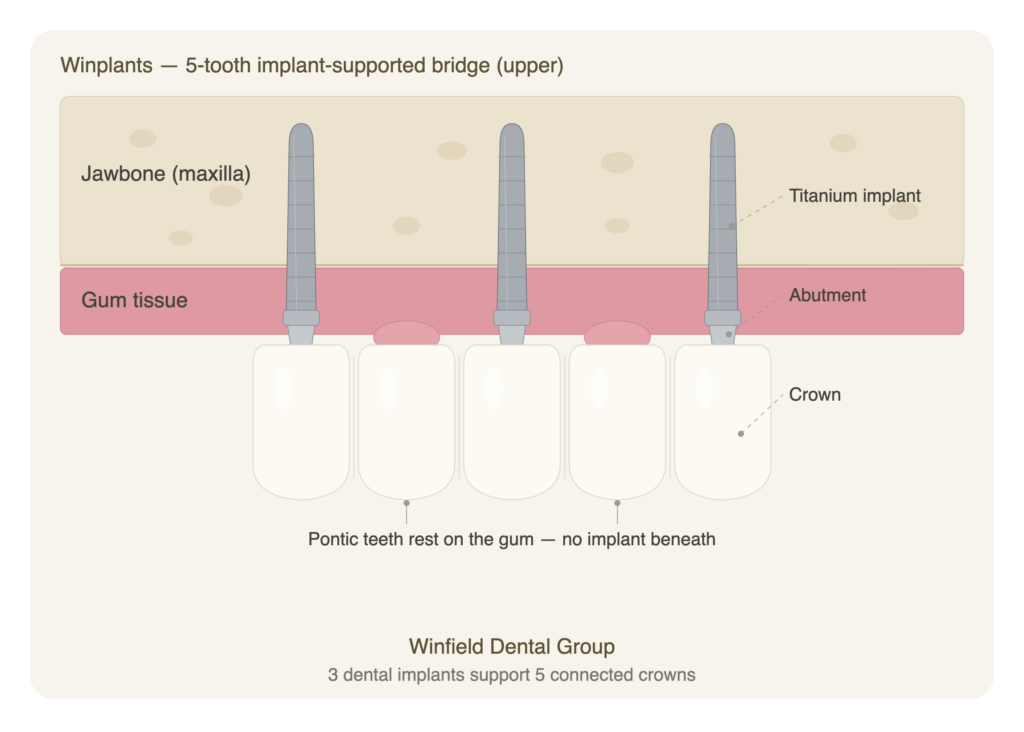
Teeth Replaced
5 adjacent
Implants Required
3
Treatment Time
4–5 months
Best For
5+ missing teeth in a row
From $15,500
From $189/mo 3.9% APR
The traditional bridge’s hidden cost is the two healthy teeth it consumes: once ground down,those teeth are committed to crowns for life — and if either anchor fails, the whole bridge fails with it.
An implant bridge uses the same engineering principle as a real bridge: strong supports at the ends, a connected span between them.
Because the implants stimulate the bone beneath the entire span, an implant bridge does what no traditional bridge or partial denture can: it stops the jawbone loss already underway in the gap.
Two or three biocompatible titanium implants are placed at strategic points in the gap, where they fuse with your jawbone (osseointegration) and become as stable as natural roots.
Precision connectors attach to each implant, forming the foundation for your bridge.
A single connected restoration of 3–4 (or more) teeth — digitally designed, shade-matched, and milled from premium zirconia or porcelain — is fixed onto the
implants. It doesn’t come out, and you care for it much like natural teeth.
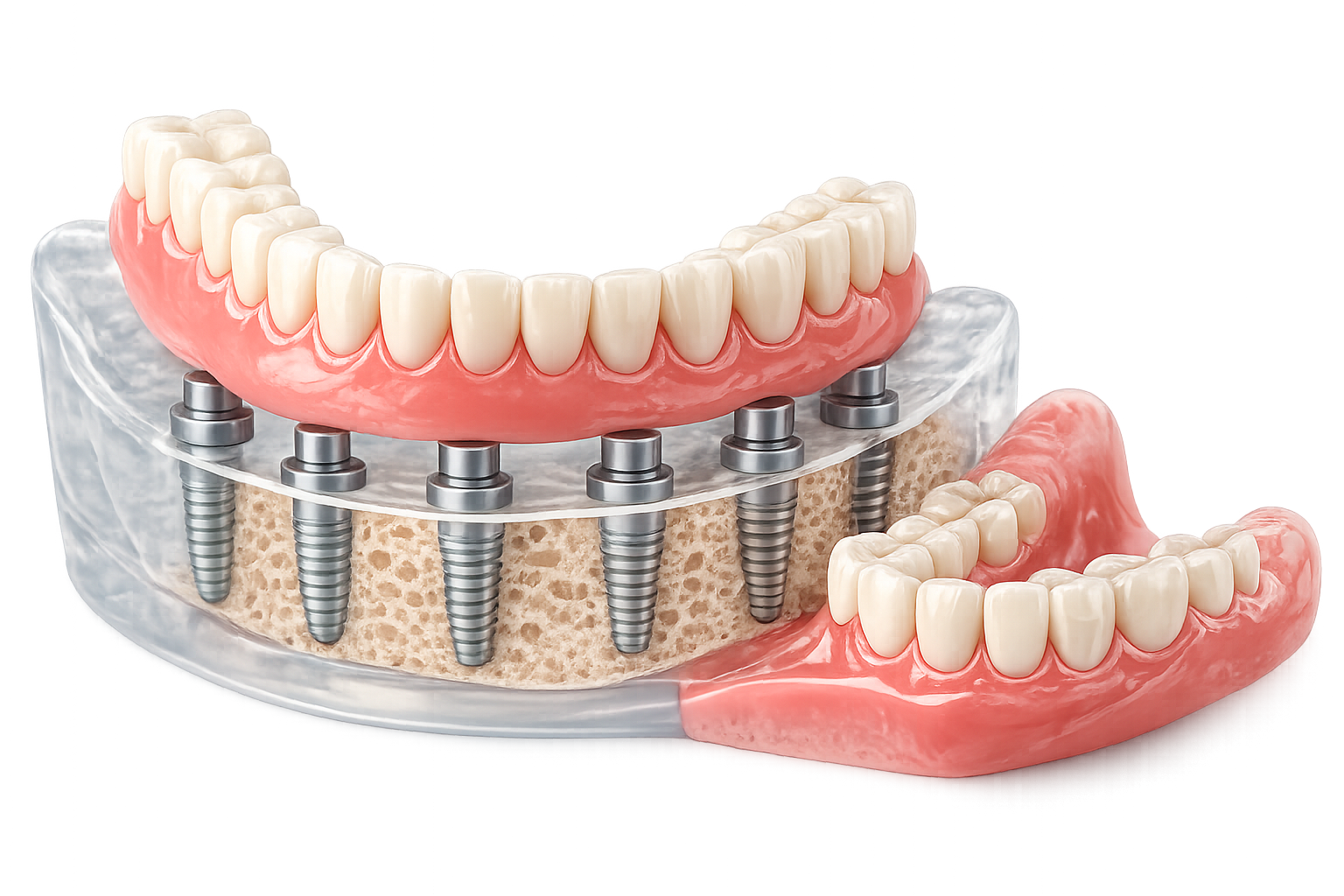
Visit 1 · Consultation
Visit 4 · Final Delivery
Which is better depends on your bone, bite forces, and the location of the gap — exactly the judgment call a board-certified prosthodontist is trained to make. In many cases, the bridge delivers equivalent function and aesthetics for significantly less. (And if you’re missing most or all teeth in an arch, [All-on-X full-arch restoration] extends the same principle to the entire arch — often more economical than multiple separate bridges.)
If you’re missing three or four adjacent teeth, you have two implant paths:
Individual implants — one implant and crown per missing tooth. Maximum independence: each tooth stands alone and can be maintained separately. But at one implant per tooth, cost scales quickly.
Implant-supported bridge — 2–3 implants carrying a connected 3–4 tooth span. You get the same fixed, bone-preserving result at a meaningfully lower total cost, with fewer surgical sites and often a simpler treatment plan.
A multi-tooth bridge is a load-bearing structure: implant positions, span engineering, material selection, and bite forces all have to be calculated together. That’s prosthodontics — literally.
Dr. Jonathan M. Winfield, DDS, FACP is a Board-Certified Prosthodontist and Diplomate of the American Board of Prosthodontics, with advanced residency training in full-mouth rehabilitation, digital dentistry, and implant dentistry at the University of Illinois Chicago, following his DDS from the University of the Pacific and his B.S. from UC San Diego. He is also trained in IV conscious moderate sedation. Every WINPLANTS bridge is planned, placed, and restored by Dr. Winfield personally — supported by the family team at Winfield Dental Group and our complete in-house digital fabrication workflow.
Because a bridge uses 2–3 implants to replace 3–4 teeth, it typically costs meaningfully less than placing an individual implant (from $5,000 each) under every missing tooth. Your exact price depends on the number of implants, the span, and materials — and like every WINPLANTS treatment, your written quote is all-inclusive: imaging, surgery, implants, abutments, the final bridge, and follow-up care, with no surprise lab fees.
Flexible payment options are available, including in-house plans, financing through our seven lending partners, and HSA/FSA payments. See our [Cost & Financing page] for the complete 2026 breakdown.
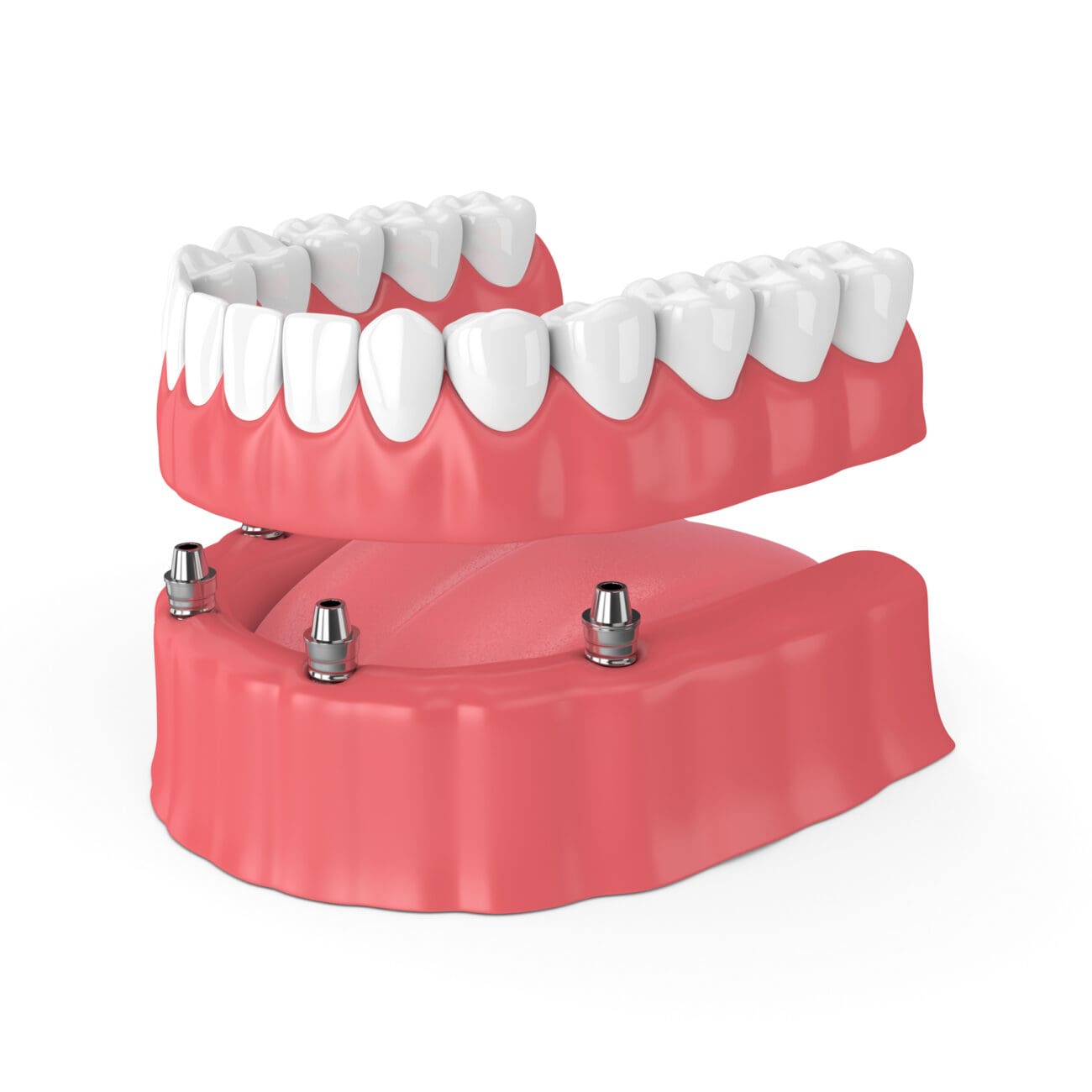
Most 3–4 tooth bridges are supported by two or three implants, depending on the span, location, and your bone quality. Longer spans or heavy bite-force areas may call for an additional implant — your CBCT scan and Dr. Winfield’s engineering of the case determine the exact number.
The implants themselves can last decades — often a lifetime — with good home care and regular hygiene visits. Premium zirconia bridges are highly resistant to wear, chipping, and staining; the restoration may eventually be replaced after many years, but the implant foundation rarely needs to be.
Usually, yes. Long-standing gaps do lose bone, but grafting can rebuild it — often at the same time as implant placement — and strategic implant positioning frequently works around moderate loss. Your 3D scan will show exactly what’s possible.
No — and that’s the point. An implant-supported bridge is fixed permanently to the implants. Only your dentist can remove it. You brush normally and clean beneath the span with floss threaders or a water flosser.
Rule of thumb: a bridge solves a section (3–4 adjacent missing teeth); All-on-X solves an arch (most or all teeth failing or missing). If your remaining teeth are healthy, a bridge preserves them. If they’re failing, All on-X may be the more economical single solution. Dr. Winfield will show you both options honestly at your consultation.
Missing several teeth in a row? Get a definitive answer — and an exact, all-inclusive price — from San Diego’s implant specialist. Start with a complimentary virtual consultation or book an in-office exam with 3D imaging.
WINPLANTS Digital 3D Dentistry — Winfield Dental Group 1111 6th Avenue, Suite 102, San Diego, CA 92101
Board-Certified Prosthodontist · Implant Bridges & All-on-X · Premium Zirconia Restorations · Fully Digital Workflow · IV Sedation · Virtual Consultations
Office Hours: Monday–Thursday, 7:00 AM – 3:00 PM · Closed Friday–Sunday
"*" indicates required fields